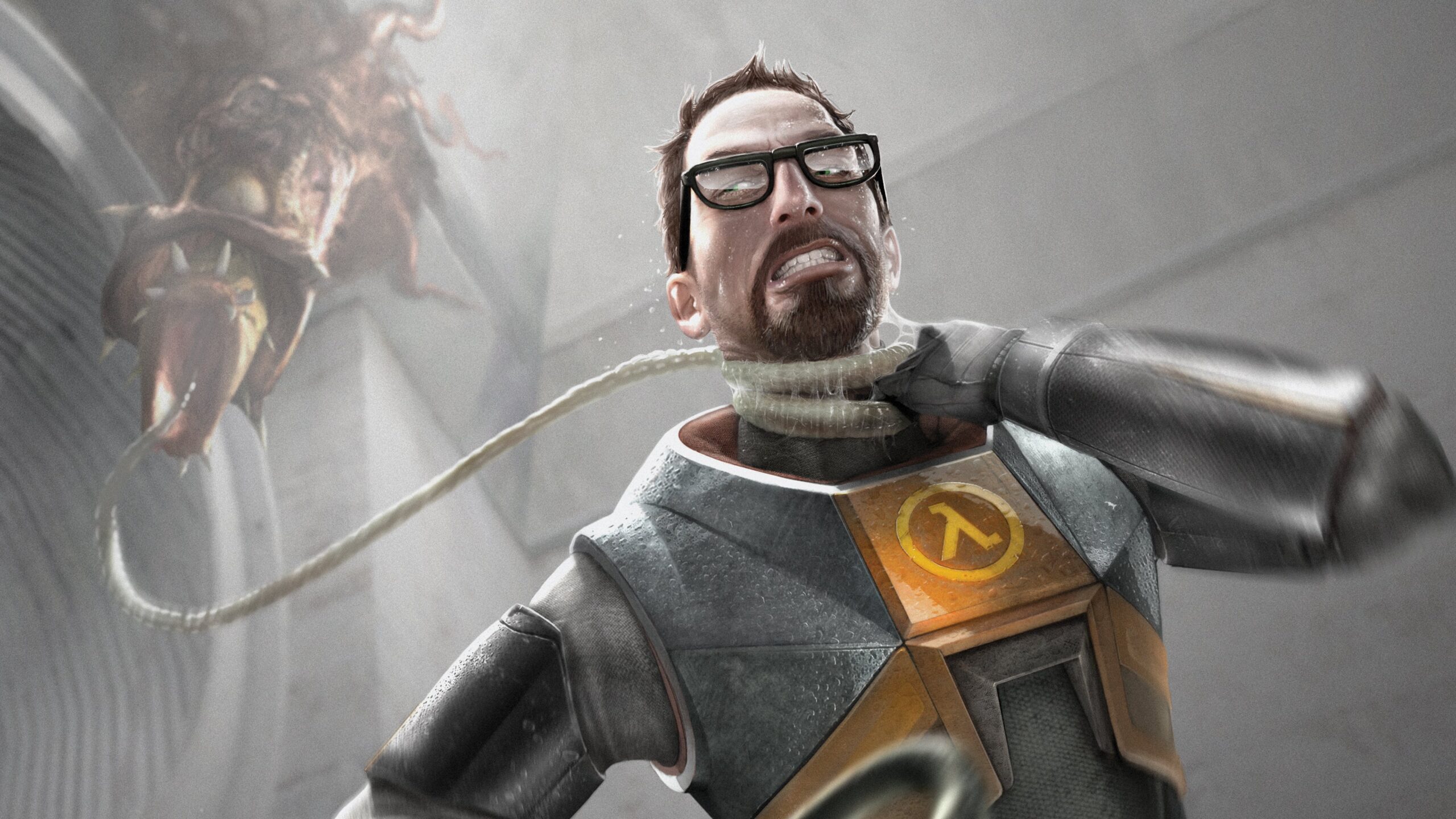
HALF-LIFE 2 Is a single-player First Person Shooter/Puzzle it also adds physics based gameplay and vehicles. It was released by the Valve corporation in 2004 ,six years after the original The player controls Gordon Freeman, who joins a resistance to liberate Earth from the Combine, a multidimensional alien empire. Created with the source engine development lasted five years and cost US$40 million Valve’s president, Gabe Newell, set his team the goal of redefining the FPS genre.
PLOT: After the alien invasion at the Black Mesa Research Facility, a multidimensional alien empire known as the Combine has conquered earth. Approximately twenty years after being placed in stasis, Gordon Freeman is inserted into a train bound for City 17 by the G-Man . Helped by the undercover Resistance member Barney Calhoun , Gordon attempts to reach the laboratory of Dr. Isaac Kleiner but is subdued by Combine officers. He is rescued by Alyx Vance , who guides him to the laboratory. Kleiner’s attempt to teleport Gordon to the Resistance base fails, and Gordon is momentarily teleported to the Citadel, the headquarters of Dr. Wallace Breen , the former Black Mesa administrator and the Combine’s puppet ruler. Gordon progresses to the base using the city’s canal system using an airboat, eluding Combine forces.
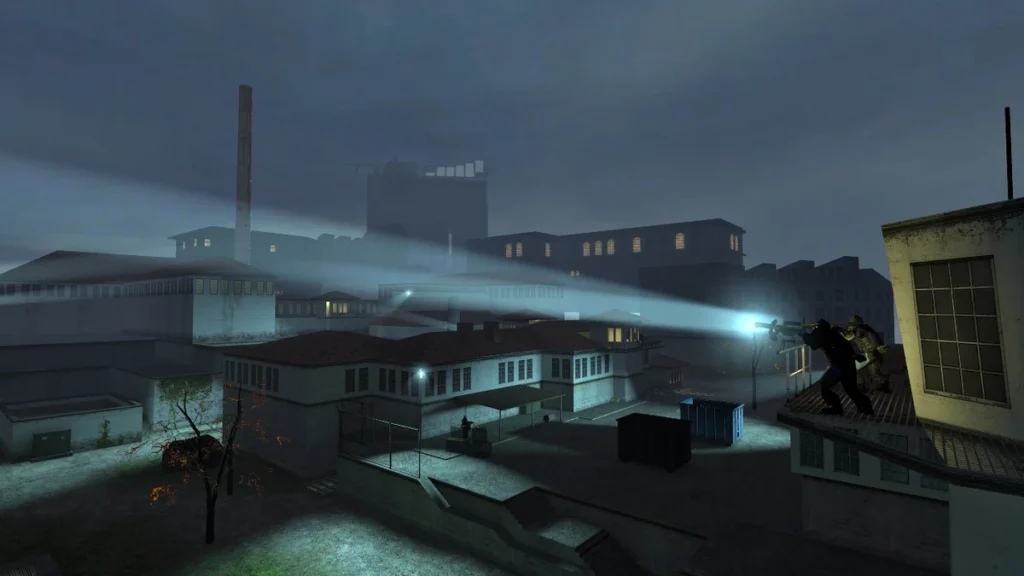
Returning to Kleiner’s lab, Gordon and Alyx learn that the teleporter malfunctioned and that a week has passed, during which time the Resistance has used the attack on Nova Prospekt to launch an armed rebellion against the Combine. Aided by Barney and Dog, Gordon fights his way to the Citadel. Inside, a security system vaporizes his weapons but inadvertently super-charges the gravity gun; this helps Gordon to progress in climbing the tower. He is captured and taken in a transport pod to Breen’s private office, near the Citadel’s apex, where he and Mossman are waiting with Eli and Alyx as captives. Breen reveals that he plans to use them as leverage during negotiations with the Combine, contradicting what he had told Mossman. Angered, Mossman frees the captives and Breen attempts to escape using a teleporter. Gordon destroys the reactor and Breen falls into the abyss. Moments after the reactor explodes, the G-Man reappears and freezes time, praises Gordon’s actions, and returns him to stasis.
At the base, Gordon reunites with Alyx’s father, Dr. Eli Vance , and meets Dr. Judith Mossman. Alyx introduces Gordon to her pet robot, Dog, and gives Gordon the gravity gun. Combine forces storm the base and capture Eli and Mossman. Gordon diverts through the headcrab-infested town of Ravenholm, aided by its lone inhabitant, Father Grigori, to a Resistance outpost whose occupants provide him with a dune buggy. He drives along the coastline to reach the Combine prison of Nova Prospekt, where Eli and Mossman are being held. Gordon and Alyx reunite, locate Eli, and discover that Mossman is a Combine spy. Before they can stop her, Mossman teleports herself and Eli to the Citadel. The teleporter explodes moments after Gordon and Alyx use it to escape Nova Prospekt.
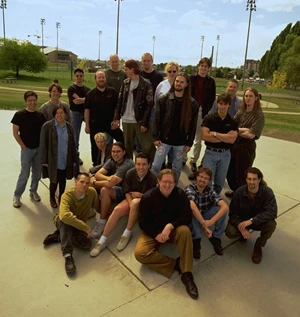
Development: Development of Half-Life 2 began in June 1999, six months after the release of the original Half-Life. It was developed by a team of 82, or around 100 people including voice actors. Valve’s president, Gabe Newell, wanted to redefine the FPS genre, saying: “Why spend four years of your life building something that isn’t innovative and is basically pointless? If Half-Life 2 isn’t viewed as the best PC game of all time, it’s going to completely bum out most of the guys on this team.” Newell gave his team no deadline and a “virtually unlimited” budget, promising to fund the project himself if necessary. They used Valve’s new in-house game engine, Source, developed simultaneously. Whereas Half-Life was set in a single location, the Black Mesa research facility, Valve wanted “a much more epic and global feel” for the sequel. One concept had the player teleporting between planets, which was discarded as it would make continuity between levels difficult. At the suggestion of the art director, Viktor Antonov, who was Bulgarian, the team settled on a city in an Eastern European location. In this early concept, players would start the game by boarding the Borealis, an icebreaker bound for the city. Nova Prospekt was conceived as a small rail depot built on an old prison in the wasteland and grew from a stopping-off point to the destination itself. After observing how players had connected to minor characters in Half-Life, the team developed the characterization, with more detailed character models and realistic animation. The animator Ken Birdwell studied the work of the psychologist Paul Ekman, who had researched how facial muscles express emotion. The writer Marc Laidlaw created family relationships between the characters, saying that it was a “basic dramatic unit everyone understands” but rarely used in games. The voice cast included Louis Gossett Jr., Robert Guillaume and Robert Culp.
Physics and design: Valve integrated the Havok physics engine, which simulates real-world physics, to reinforce the player’s sense of presence and create new gameplay. To experiment, they created a minigame, Zombie Basketball, in which players used a physics-manipulating gun to throw zombies through hoops. In mid-2001, to test the physics and non-player characters, Valve built a battle between rioting citizens and police. In late 2001, Valve began creating a showreel, hoping to demonstrate it at E3 the next year. For several months, Newell let the team work without his input so he could provide unbiased feedback, and focused on developing Steam, Valve’s upcoming digital distribution service. The team presented the showreel to Newell, showcasing physics, environments such as the Borealis, and a dialogue-heavy scene with the scientist character Dr. Kleiner. Newell felt the showreel did not adequately show how the physics would affect gameplay and that the Kleiner scene was overlong. Reflecting on the feedback, Laidlaw concluded that the character drama had to support interactivity and gameplay. In September 2002, the team completed a second showreel, featuring a buggy race along the City 17 coast, an encounter with headcrabs on a pier, an alien strider attacking the city, and a greatly shortened Kleiner sequence. In October, Newell told the team they would announce Half-Life 2 at E3 2003 and release it by the end of the year. As with the original Half-Life, the team split into “cabals” working on different levels. Designers created levels using placeholder shapes and surfaces, which then were worked on by the artists.
Reception: Half-Life 2 has an aggregate score of 96/100 on Metacritic based on 81 reviews. Sources such as 1UP, GameSpy, The Cincinnati Enquirer, The New York Times, and VideoGamer.com gave it perfect scores, and others, such as PC Gamer, IGN, GamesRadar, and Eurogamer, gave near-perfect scores. It was the fifth game to receive ten out of ten from Edge. Critics praised the graphics, physics, story and gameplay. Maximum PC awarded Half-Life 2 11 on their rating scale which normally peaks at 10, calling it “the best game ever made” .I n the United States, Half-Life 2’s PC version sold 680,000 copies and had earned $34.3 million by August 2006. It was the country’s 17th best-selling PC game between January 2000 and August 2006. It received a “Platinum” sales award from the Entertainment and Leisure Software Publishers Association (ELSPA), indicating sales of at least 300,000 copies in the United Kingdom. Forbes reported on February 9, 2011, that the game had sold 12 million copies worldwide. In a review of The Orange Box, IGN stated that although Half-Life 2 has already been released through other media, the game itself is still enjoyable on a console. They also noted that the physics of Half-Life 2 are impressive despite it being a console game. However, it was noted that the graphics on the Xbox 360 version of Half-Life 2 were not as impressive as when it was released on the PC. GameSpot’s review of The Orange Box noticed that the content of both the Xbox 360 releases, and PlayStation 3 releases were exactly alike, the only issue with the PlayStation 3 version was that it had noticeable frame-rate hiccups. GameSpot continued to say that the frame rates issues were only minor but some consider them to be a significant irritation. Several critics, including some that had given positive reviews, complained about the required usage of the program Steam, the requirement to create an account, register the products, and permanently lock them to the account before being allowed to play, along with installation difficulties and lack of support.
| Publication | Score |
| 1Up.com | A+ |
| Edge | 10/10 |
| Eurogamer | 10/10 |
| GamePro | 5 stars |
| GameSpot | 9.2/10 |
| GameSpy | 5 stars |
| GamesRadar+ | 5 stars |
| IGN | 9.7/10 |
| Maximum PC | 11/10 |
| PC Gamer (US) | 98% |
| VideoGamer.com | 10/10 |
| The Cincinnati Enquirer | 4 stars |
| The New York Times | Positive |